
- Your Best Customers Are Telling Your Story
- Then Someone Tells a Different Story
- Your Reply Is Part of the Story Too
- Don’t Try to Win the Argument
- Negative Review Response Examples: What to Say
- What If the Customer Is Wrong?
- How to Delete a Google Review: When to Report Content
- The Best Response May Be a Change in Your Business
- You Can’t Control Every Review
Every business has moments it is proud of. A customer walks out happy, sends a message saying, “Thank you, you made this so easy,” or returns six months later to recommend you to a friend. Sometimes, customers put those experiences into words online, and a new five-star review appears.
When another customer reads those kind sentences, they think: “Maybe I’ll try this business too.”
That is the beautiful thing about online reputation management. Your customers can say things about your business that your advertising never could. They aren’t trying to sell anything; they are simply sharing what happened to them, which makes their words incredibly powerful.
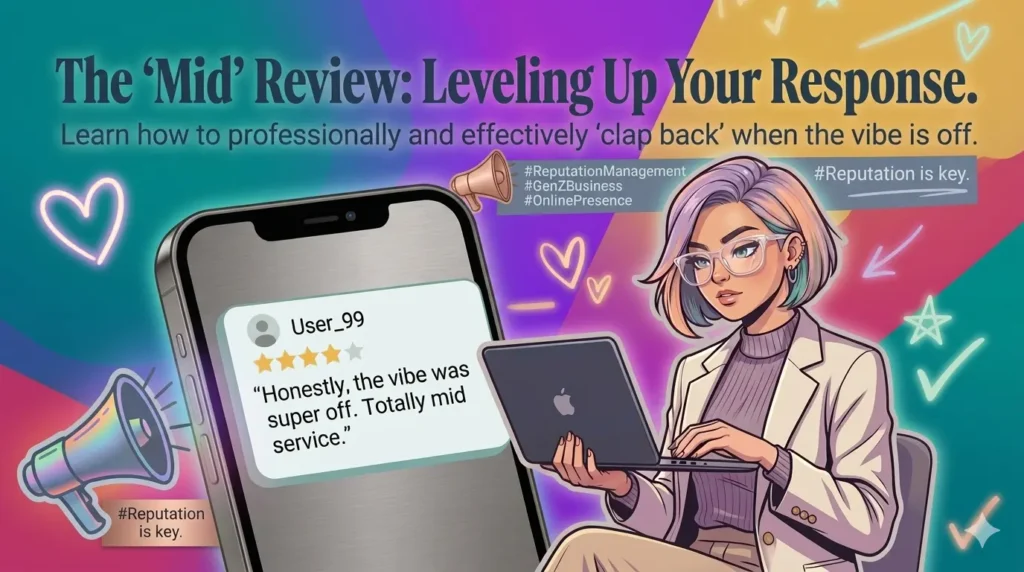
But customers do not always have the same experience. Sometimes someone leaves a review that tells a very different story. When that happens, the review becomes a permanent part of your brand story too.
Maybe the customer had a genuine problem, maybe there was a misunderstanding, or perhaps your business simply made a mistake. Whatever happened, the 1-star complaint is now sitting publicly on Google.
Your first instinct might be to jump into the comments and explain your side. That is completely understandable because there are always two sides to every story. But here is the critical thing to remember: the person reading the review doesn’t know either side.
They weren’t there, they don’t know the customer, and they don’t know you. They are simply trying to decide whether your business is safe and trustworthy. This is exactly where your response strategy becomes vital.
A potential customer doesn’t just see the negative feedback; they can also see exactly what you chose to say afterward. That means your response becomes a fresh piece of evidence they use to judge your business ethics.
Imagine two competing businesses receive almost identical complaints.
The first replies:
“This is completely untrue. You clearly misunderstood everything.”
The second says:
“We’re sorry your experience wasn’t what you expected. We’d like to understand what happened and see how we can help.”
The customer reading both profiles has no idea which business was actually right. However, they can see exactly how each business behaves when things become uncomfortable. Learning how to respond to negative Google reviews isn’t simply about writing a quick defense. It is about showing future buyers how you treat people when things don’t go perfectly. Google’s official merchant guidelines recommend keeping review responses professional, helpful, relevant, and personalized rather than relying on automated, generic replies.
This is arguably the hardest part of managing online business reviews. Sometimes you know with absolute certainty that the customer is wrong. You have the emails, you have the invoices, and you know what actually happened.
So why shouldn’t you lay out all the facts to prove it?
Because your response is a public relations statement, not a courtroom submission. The primary goal is not to convince the unhappy customer that they made a mistake. The real goal is to make sure the next prospective customer doesn’t walk away thinking: “I don’t want to deal with a business owner who snaps at people.”
You can correct misinformation without launching an attack. You can explain a company policy without sounding defensive, and you can disagree without being disrespectful. Sometimes, saying less says much more to the public.
There isn’t a single magic template because every situation is unique. However, an effective, professional response always features a few simple, human ingredients.
- Acknowledge the experience: You don’t have to agree with their version of events. You can simply validate their disappointment.
- Own real mistakes: If your business dropped the ball, say so clearly. A brief, honest apology builds far more trust than a paragraph of excuses.
- Provide calm context: If a fact is completely wrong, clarify it gently without turning your reply into an angry defense.
- Move it offline: Invite the customer to discuss the issue via phone or email to protect customer privacy and keep the public feed clean.
Plug-and-Play Response Templates
Scenario 1: The Service Drop (When you made a mistake)
“Hello [Name], thank you for the feedback. We pride ourselves on fast service, and it’s clear we missed the mark during your visit. We have addressed this with our team to ensure it doesn’t happen again. Please reach out to us directly at [Email/Phone] so we can make this right for you.”
Scenario 2: The Misunderstanding (When expectations didn’t match reality)
“Hello [Name], we are sorry to hear that you were disappointed with your experience. We always aim to be fully transparent about our timelines and pricing before we begin work. We would welcome the chance to speak with you directly at [Email/Phone] to clear up any confusion and assist further.”
This is where your professionalism truly shines. You do not have to apologize for something your business did not do, but you also do not need to humiliate the reviewer publicly.
Instead of typing:
“You’re completely wrong. You obviously didn’t read our policy.”
You can choose a more calculated approach:
“We’re sorry you were disappointed, [Name]. We reviewed our internal logs and verified that the service followed our standard, stated safety policies. However, we want to ensure all our guests leave satisfied. Please contact our manager directly at [Email/Phone] so we can hear your concerns.”
Both responses hold the exact same business line. Yet, they leave entirely different impressions. The first response forces the reader to pick a side, while the second proves that your business can handle a disagreement with grace. That is a powerful reputation signal.
When hit with unfair 1-star feedback, many owners immediately search for how to delete a Google review. The reality is that business accounts do not have a “delete” button for user content. Disliking an uncomfortable opinion or disagreeing with a customer’s perspective is not a valid reason for removal.
However, Google allows you to flag and report reviews if they explicitly violate Google’s Prohibited and Restricted Content policies.
| Removable Content (Flag It) | Non-Removable Content (Respond to It) |
|---|---|
| Fake reviews from direct competitors | Genuine complaints about slow customer service |
| Harassment, hate speech, or profanity | Frustrated opinions about your pricing structure |
| Spam or completely irrelevant text/photos | Misunderstandings regarding your store policies |
To report a violation, click the three dots next to the review on Google Maps, select “Report review,” and choose the appropriate policy violation. Do not build your online presence by trying to make every negative piece of feedback disappear; build it by out-shining the bad days with excellent service.
Sometimes the most effective response to a negative review isn’t a sentence at all—it’s an operational change.
If multiple customers leave reviews complaining about slow communication, you could continue pasting the same generic reply: “We’re sorry you feel this way. Customer satisfaction is our top priority.” Or, you could look internally and ask why customers are waiting so long in the first place.
Perhaps your contact form is broken, your support staff is overwhelmed, or your automated confirmation emails are confusing. Fix that operational bottleneck, and the next customer will have a seamless experience. That is when true reputation management happens: you stop managing what people say about your business and start improving the system that gives them something to say.
You cannot make every single customer happy, you cannot prevent every single communication mix-up, and you certainly cannot control what someone types into a search engine.
But you have total control over how your business shows up in the aftermath. A negative Google review is just a single chapter in your business journey, not the whole book. By responding with empathy, calm clarity, and absolute professionalism, you turn a bad review into undeniable proof that your business cares.
You can’t hide the review. But you can always choose to add more clarity.
.